
One Family Restored Their Lake Cabin Hillside
You have a place that’s important to you. I know you do. Maybe it’s a place you haven’t been to in a long time. Maybe you live there now. Maybe it doesn’t exist anymore in the way you remember it, from whatever special time in your life that place surrounded your heart.
It’s these places that inspire us to hold onto memories, to pass them down, to want our children and future generations to experience the same things we did. We long to live on through the experiences that built us — that our parents gave to us, and their parents gave to them. If not the exact place, at least a facsimile of it.
The Storm of a Century
For Heidi Ferris (Growing Green Hearts) and her family, it’s a century-old lakeside cabin and, more importantly, the property it rested on. There comes a time for all places to change drastically for their composition to alter and become something new. In the case of this hillside cabin sanctuary, two monolithic trees had ended their long run, no doubt just saplings at the time the original cabin was built. Together, the heritage oak and the towering red pine, along with the cabin itself, watched generations of Heidi’s family grow and develop an undeniable love of the land. Nothing lasts forever — nothing physical, anyway — and through a great Midwestern storm, this chapter concluded. Thunder and lightning brought down the watchful trees and the family cabin.
So then what? A family cabin, a century’s worth of memories — to be given up on and forgotten?
Yeah…right.
Heidi’s family made the easy decision to rebuild the cabin, this time building something that could be shared year-round among the 40 friends and family members who call this place theirs. But a new cabin alone wasn’t enough. After the storm, the hill was left vulnerable. A slope approaching 45 degrees sent water running straight down through a tangle of invasive buckthorn, reaching the shoreline with enough force to eventually erode the hillside entirely. To protect the cabin, the hill itself would need to be rebuilt, restored, stabilized.
And then came the realization: the storm hadn’t taken anything, but it had given a new structure to the property.
Using What the Storm Left Behind
The two great fallen trees — the heritage oak and the towering red pine that had stood watch over so many summers — were still there. Still useful. Still part of the story. Rather than hauling them away, the family worked with local conservation experts to place them with intention, laying the logs along the hillside as terraces to slow the water, hold the soil, and anchor everything that would come next. The same trees that once shaded the porch now shelter the roots of something new. What the storm took in one form, it returned tenfold in another.
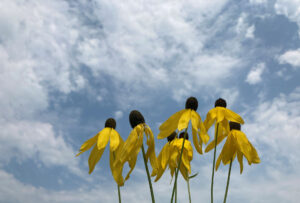
Behind those log terraces, native prairie plants took hold — blazing star, purple coneflower, lead plant with roots that deep into the earth creating pathways deep down the hillside allowing water to travel deeper and filtered before reaching the lake. Plants that don’t just survive here; they belong here. They clean the water, feed the pollinators, and anchor the hill against the next storm and the one after that. Up at the top of the slope, a rain garden now catches water off the roof before it ever reaches the hill. At the shoreline below, native plantings hold the bank. The whole system breathes together.
This is what love for a place looks like when it gets its hands dirty. It’s not preservation for its own sake — it’s transformation in the spirit of what came before. The old cabin is gone, but forty people still gather. The trees are down, but the hillside holds. The place has changed, as all places do, and in changing, it has been tended back into meaning.
Your place may be gone too. Or fading. Or just different enough to ache a little when you think about it. But Heidi’s story is a reminder that the love we carry for the places that shaped us doesn’t have to be passive. It can pick up a log. It can plant a seed. It can call in the family and get to work.
Its the connection between community and nature, between place and memory. There are many kinds of roots and they all run deeper than we know… and they all hold us in place.
If you’re looking at a steep hillside, a struggling shoreline, or just a patch of lawn you’re ready to reimagine — this kind of project is more within reach than you think. With the right guidance, the right plants, and a community willing to show up, it’s absolutely something you can do yourself. Start by connecting with your local watershed district or county conservation office, and ask about cost-share programs that might already exist in your area.
And if you’re ready to get your hands in the soil but want expert eyes on the project, MNL works with homeowners, families, and communities at exactly this scale — from hillside stabilization to shoreline restoration to native plant design. They can help you build a plan that fits your land, your budget, and the people who love the place as much as you do.
Leave a Reply